





Boom Cities: architect-planners and the politics of urban renewal in 1960s Britain

|
| Boom Cities: architect-planners and the politics of urban renewal in 1960s Britain, Otto Saumarez Smith, Oxford University Press, 2019, 198 pages, 31 black & white illustrations. |
Otto Saumarez Smith, an assistant professor at the University of Warwick, recognises himself ‘as part of a generation born after the glory days of the welfare state which looks back on the physical remains of this vanished era with nostalgia for a lost idealism’. Boom Cities deals with a subject that has received an overwhelmingly negative press: the redevelopment of city centres in the 1960s, from the more balanced and nuanced perspective of a young scholar who was not there at the time.
Saumarez Smith identifies 1963 (the year of publication of Traffic in Towns, Wilfred Burns’ plan for Newcastle and Peter Hall’s vision of the London region in 2000) as a high point of city-centre redevelopment. It was a period of economic prosperity, optimism and an assumption that motor traffic could grow almost without limit. These were views shared across the political parties. Consultancies and local authorities employed the dual-qualified architect-planners who would reshape cities to reflect the 60s zeitgeist. Konrad Smigielski’s 1964 Leicester Traffic Plan rode this wave of positive energy. The plan, like Smigielski’s work in general, had much in it that was good, including an emphasis on public transport. But, with elements like a monorail system, it proved over-ambitious.
Blackburn’s was one of the earliest and most radical redevelopment schemes, promoted by a public private partnership. It covered six hectares of the city centre, separating traffic and pedestrians. The result was praised at the time by critics such as Ian Nairn, and Saumarez Smith finds Blackburn still worthy of respect. Graeme Shankland’s plans for Liverpool and Bolton followed; his unbuilt plan for Hook new town provided a model. The excitement generated by Shankland’s radical plan for Liverpool was not followed through and left large areas of dereliction. The plan for Bolton was more successful. The aristocratic Lionel Brett had a more incremental approach than Shankland in his plans for Hatfield new town and Portsmouth, and in his 1966 conservation study for York. By 1970 Brett had moved to advocating a restrained approach to redevelopment before his career took off in a different direction.
Tracing the overall trajectory of city-centre redevelopment, Saumarez Smith quotes Richard Crossman, minister in the 1964 Labour government, admiring the rigorous geometry of Cumbernauld while privately suspecting that most people would prefer the kind of living environment offered by Welwyn Garden City. Crossman was also concerned about the contrast between ambitious drawings and poor quality in the corresponding built schemes. Saumarez Smith identifies a mismatch between schemes designed on the basis of an assumption of future affluence and the reality of cities like Stoke-on-Trent which were moving towards a post-industrial state. He ends the book with a useful plea for a holistic view of the post-1945 legacy, including ‘the shopping centre, the roads and the underpasses’. The story, he concludes, has ‘its share of both idealism and crassness’ and ‘doesn’t fit neatly into a polemic’.
Older readers may find that the author’s portrayal of ‘architect-planners’ as urban power brokers does not quite ring true: in the reviewer’s memory these professionals were sometimes ruminative types who developed an interest in the then niche field of conservation. Academic publishing is clearly challenging but it is a pity that the price of the book may deter many who would find Boom Cities interesting and enjoyable. This is a brilliantly researched and very readable book.
This article originally appeared as ‘Redevelopers and ruminants’ in IHBC's Context 161 (Page 61), published by The Institute of Historic Building Conservation in September 2019. It was written by Michael Taylor, editorial coordinator for Context.
--Institute of Historic Building Conservation
Related articles on Designing Buildings Wiki
- Adam Curtis - The Great British Housing Disaster.
- Ballymun mass housing and regeneration.
- Barlow report.
- British post-war mass housing.
- Brutalism.
- Conservation.
- Garden cities.
- Housing contribution to regeneration.
- IHBC articles.
- Modernist Estates - Europe: the buildings and the people who live in them today.
- Municipal Dreams: the rise and fall of council housing.
- New Town Development Corporation.
- New towns.
- The Institute of Historic Building Conservation.
IHBC NewsBlog
IHBC sponsors Gardens Trust event 23-4 Sept 2026
.jpeg)
'Learning from the Past, Shaping the Future’ takes place in Milton Keynes
Renovations to Frank Lloyd Wright's Fallingwater complete
.jpg)
World Heritage Preserved project opens house for tours again
Shakespeare Birthplace Trust places Hall's Croft on HAR Register
Stratford-upon-Avon home of Shakespeare's daughter is 'At Risk'
Lady Grange’s House repaired on St Kilda
.jpg)
National Trust for Scotland repairs stone cleit with link to famous island resident
Griff Rhys Jones on BBC Radio 4 Today programme
,_Green_Lane,_Derby.jpg)
The Victorian Society’s President unveiled its latest Top Ten Endangered Buildings 2026.
Need a MATE? Book your place now.
IHBC offers free webinars on applying for IHBC accreditation (Full & Associate).
UK Stained Glass Repository finds windows new homes
How are stained glass windows are rescued, stored and repurposed?
APPGEBE report sets high aims for quality
'Government must not sacrifice quality in drive to build 1.5m homes'
New measures protect Historic Shipwrecks from heritage crime

Underwater cultural heritage benefits from new HE guidance
How could the City of London skyline look in 6 years' time?

Visualisation shows approved planning applications as completed buildings
National Trust for Scotland calls for VAT cuts
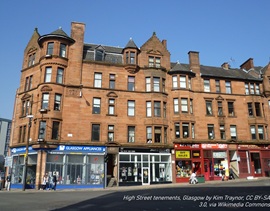
Heritage neglect is encouraged by current policies
IHBC's 'Context' Issue 186 features Industrial Heritage
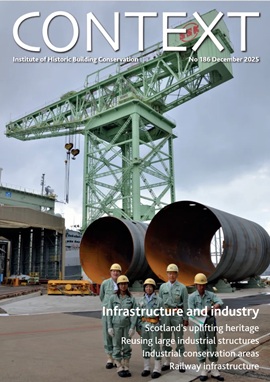
IHBC's members' journal reports on the challenges of conserving infrastructure
Book now for IHBC Annual School 2026
IHBC Annual School is taking place 18-20 June 2026 in Newcastle
RICHeS Research Infrastructure offers ‘Full Access Fund Call’

RICHeS offers a ‘Help’ webinar on 11 March
Latest IHBC Issue of Context features Roofing
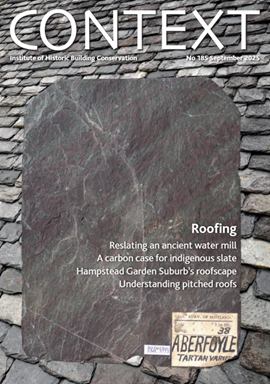
Articles range from slate to pitched roofs, and carbon impact to solar generation to roofscapes
Three reasons not to demolish Edinburgh’s Argyle House

Should 'Edinburgh's ugliest building' be saved?
IHBC’s 2025 Parliamentary Briefing...from Crafts in Crisis to Rubbish Retrofit
IHBC launches research-led ‘5 Commitments to Help Heritage Skills in Conservation’
How RDSAP 10.2 impacts EPC assessments in traditional buildings

Energy performance certificates (EPCs) tell us how energy efficient our buildings are, but the way these certificates are generated has changed.